


If you were paying attention a week or so ago, you will have read my review of Wendy’s fabulous new MG novel, Honey and the Valley of the Horses. Now I have the great pleasure of introducing Wendy to you in this Q&A.
Welcome to Just So Stories, Wendy, and what a privilege it is to be able to share some conversation with you to my blog friends.
I’m going to start with the most recent first, that is, Honey and the Valley of the Horses, which is just such a tender and heart-warming narrative. I know you mention that it was reflecting on Covid’s impact on children that was a catalyst for this novel, could you elaborate on that for us?
Our son, daughter-in-law and their two children – aged nine months and two and a half year, lived with us for most of that first year of lockdown. We were all aware, not only of the toddlers’ shyness and overwhelm around strangers, but that these uncertainties were now the norm. As schools began to reopen, neighbours expressed their fears, some deciding to continue home-schooling, others struggling with their children’s fears of leaving the home to attend. A close friend who specialises in child and adolescent mental health also talked about her concerns, and the overwhelming demand on mental health services because of this isolation and fear. I felt very strongly that it was important to continue to help kids (and adults!) realise that although there may be threats in the outside world, we need to reach out and participate in order to grow.
Your body of work ranges over many genres and topics from Nim’s Island to the Rainbow Street Pets series, to picture books and to (certainly my favourites) the Bronze Age novels.
Where does the inspiration for such a diverse collection come from?
The short answer is that I really don’t know! I simply seem to find a story that I want to tell, and then figure out how it wants to be told. I can generally trace backwards to find the instigating idea, but what I don’t know is why the books have ended up crossing such a wide range. The only thing I know for sure is that I thrive on the challenge of attempting new things, and don’t find it as fulfilling to write within my comfort zone.
And do you have a preferred genre to write in?
If I had to choose one: middle grade fiction, and magic realism.
Which do you find most difficult?
Picture books.
You mentioned the Bronze Age novels – Dragonfly Song took me about 10 years to work out the way it needed to be told, but the real difficulty there was accepting that combination of verse and prose, and telling my publisher (who was very supportive once I’d told her!). The verse itself was a gift, flowing easily; in fact many of the prose sections of those three novels were written in verse and then transposed into prose.
You have some excellent advice for budding adult writers on your website, but what approach/es do you suggest for children in their writing?
Read a lot and write a lot.
Experiment with reading different styles and genres; it’s okay to read books that are for younger kids as well as the ones that challenge you, and it’s also okay to stop reading a book that you’re really not enjoying. There are many, many good books in the world – find ones that grab you or take you wherever you need to be at that moment.
Have fun with your writing – and, similarly to your reading – if you stop enjoying the story you’re writing, don’t finish it. You’ll find many more ideas that you want to spend time with. Think of your story as a game, or your characters as your imaginary friends. If you’re not having fun writing it, no one will have fun reading it.
Try drawing a map of your story’s location.
Even if you don’t think you’re good at drawing, try drawing your characters; you may find you understand them better once you’ve done that. When you’re rewriting and editing, read your story aloud: to yourself, a pet, your family or your class. (But if you’re going to read to your class, definitely read it aloud to yourself first!) Reading aloud will help you notice little mistakes or things that don’t sound quite right.
Don’t worry about publication – but if you see a competition for your age group, be brave and enter!
I know you have lived in Australia for many years but your childhood was quite nomadic in a sense, due to your father’s air force career. What was life for young Wendy like? Which of your ‘home’ countries remains most special in your memories?
My childhood was definitely nomadic! Between preschool and Year 12, I went to 11 schools, in three countries and two languages. I remember it as being essentially happy and stable, which obviously means my parents put in quite a bit of effort into keeping it that way. However there was certainly grief at leaving each home and trepidation at starting each new school; I learned to stand back and observe before venturing in to new social situations. That can be good, but it also gave me the bad habit of not asking too many questions for fear of being laughed at.
I think there’s a tie for the most special home spot: the French village where I finished kindergarten, had a complete year of Grade 1, and started Grade 2. We had a tiny house in an enormous garden, and our wonderful landlords, who came out every weekend to work in the garden, became our foster grandparents. (They became Mr and Mrs Noah in Ark in the Park – which apparently was given a little shrine in their house!) I also made a lifelong friend in the sandbox my first day at the kindergarten; Jacqueline taught me to speak French – she still encourages and corrects me when we speak on the phone! (She grew up to be a special needs teacher, as well as writing scripts for musicals. And starred as herself in my Yasou Nikki!) I think it was those relationships, as well as the garden, that still make me feel at home when I’ve been able to visit, and make me feel truly happy when I’m speaking French, rusty as it is now.
But Canada’s Vancouver Island is another place that still makes me deeply happy. We never lived there, but as my parents were both from the area they bought a rough cabin on a couple of acres, and we visited it for holidays whenever we lived in the west of the continent.
(That’s such an interesting question, that I’ve never been asked before – proof that asking questions is actually a good habit!)
You’ve certainly garnered much acclaim over your writing career for various of your books. Which award or accolade has had the most significance for you?
Obviously winning the CBCA is pretty wonderful, but I think the most special was actually the first time I was shortlisted, for Leaving it to You in 1993. I’d heard of the shortlist and understood its importance, but had no idea of the timing of the announcement. My main focus that day was 18 months after breaking my neck in a car accident, I had finally accepted that I would not be returning to work and was clearing out my Occupational Therapy office. Anticipating the devastation I’d feel, I’d booked a psychologist’s appointment for the afternoon. However when I walked in, the receptionist said, ‘Your husband’s been leaving messages for you all morning – something about a shortlist!’ (Hard to remember that pre-mobile phone period of history.) The significance could not have been greater. It was my fourth book, but, especially after so much of my other identity had been stripped away, I didn’t feel I could call myself a writer. Now I knew I was.
And winning the Prime Minister’s Award for Dragonfly Song was just amazing. That’s probably my other peak.
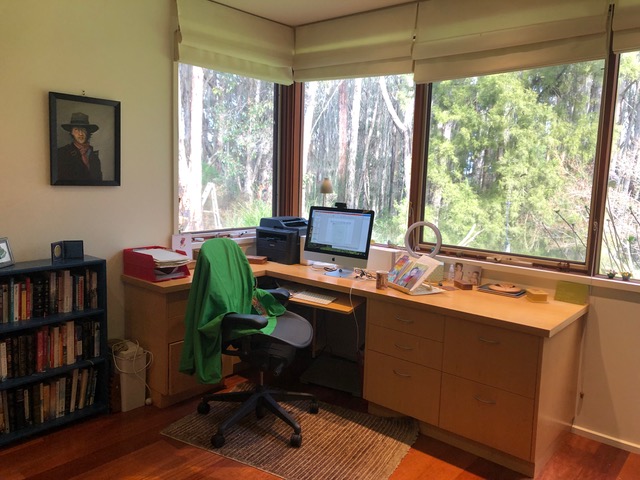
What does your working space and day look like? (photos are always appreciated!)
I’m lucky enough to have a home office with lots of light, looking onto the bush. I love it. The desk was built for me as my gift to myself after the Nim’s Island movie came out. It’s not usually as tidy as it is in this photo (the general look is more often as if someone upended a couple of reams of scrap paper across the desk). I do nearly all my work here, though if I’m writing by hand, as I do for any free verse and some other passages, I spread out at the kitchen table.
I usually check social media and emails at breakfast, and then start work after walking the dog.
How would you sum up yourself in one short sentence?
A practical dreamer.
Wendy, thank you so very much for your time and generosity in sharing. I know many of my blog friends will enjoy this insight into your work, inspiration and life.


 Just So Stories
Leave a comment