


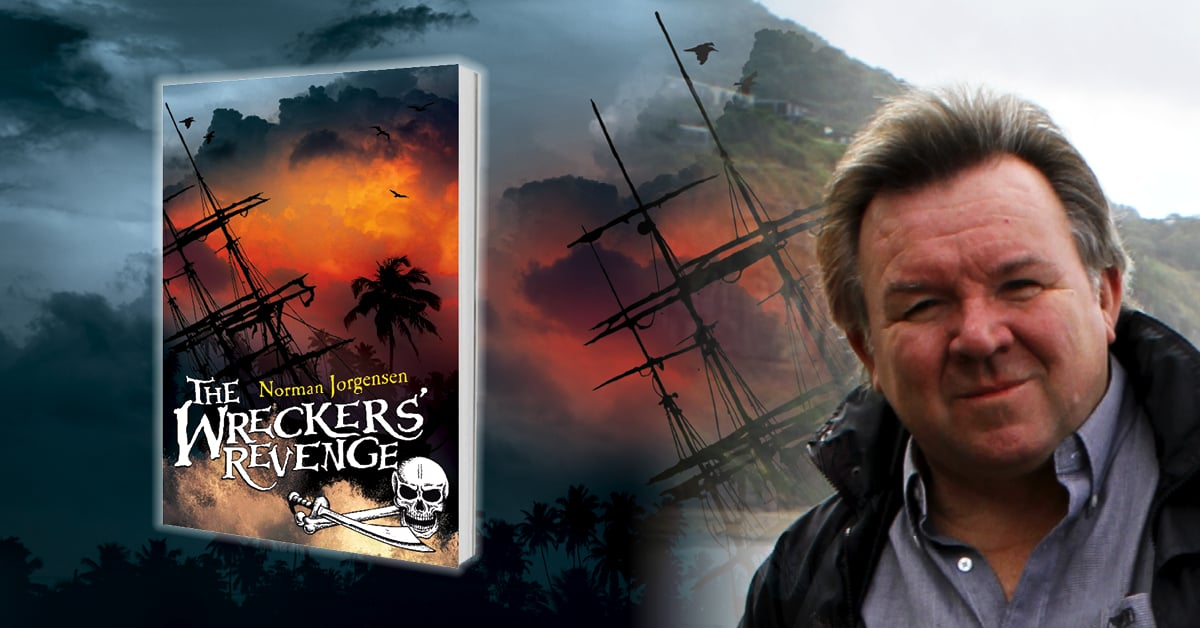
Greetings, Norman, and welcome to Just So Stories! Thanks so much for spending time with the readers here and giving us the lowdown on NJ’s life and times.
Not everyone will have seen glimpses of your childhood via your social media, so let’s start there.
What was little Norman like as a child? Tell us about your family and where you grew up. We want to know if you were the goody-two-shoes or the rascal at home or school.
I am the oldest of four boys, and we spent our early years in country Western Australia in Broome, then Mullawa and Narrogin in the state’s dry and dusty wheat belt. I wasn’t particularly naughty, but living in a country town gave me a lot of freedom to explore and go on real and imaginary quests, and I had Ian, Bruce, and Colin to share my real and imaginary landscape. Many of my adventures were inspired by the books I read and our weekly visits to the Narrogin Saturday afternoon flicks. They showed a lot of cowboy films, and even now, well over half a century later, both my brother Ian and I are die-hard Western addicts.
School was a bit tougher as I was no good at sport, nor the least bit interested, and living in a country town, that is social leprosy. I became quiet and shy, but it didn’t bother me too much as I discovered reading and found I would rather sit under a tree by myself with a book than mindlessly kick a footy back and forth like a brain-dead zombie. For someone who is still shy even now, I do seem to spend a lot of time acting like I am not while out attending events, giving school talks, and talking to great crowds of people.
I imagine you as a child reader. What were your favourite books and authors? Which of them still resonates with you today as an adult?
Too right! When I was seven, my parents could see I was bored with Dick and Dora and Fluff running up hills, so my dad brought home from the town library Enid Blyton’s The Adventures of Secret Seven and like vast numbers of kids of my generation, I was instantly hooked. For the first time, I realised that books could be excruciatingly funny, dangerously exciting, and completely unputdownable. Dad then started buying them and The Famous Five for me every second Thursday – Commonwealth Public Servant payday.
I discovered and loved the seafaring adventure of Robert Louis Stevenson’s Treasure Island, and, in fact, my books, The Smuggler’s Curse and The Wreckers’ Revenge, are so heavily influenced by RLS that it is almost embarrassing. I often tell kids that his ghost was guiding my fountain pen as I wrote the first draft while staying in the same lighthouse keeper’s cottage as he did in the windswept Shetland Islands, far north of Scotland.
What were your big dreams as a kid?
I wanted to run away to sea to travel the world and seek out all the places I had spent so much of my childhood reading about. The first stop would have been Tombstone, Arizona, then the mean noir streets of New York, followed by all the battlefields and castles of Britain, the caves and coves of Enid’s Cornwall, and the wild bleak moors of Scotland, especially the locations described in Kidnapped. And that was to be just the start of my adventures.
What was your first job, and what came after that?
My first job was as a delivery boy for the local chemist in Kalamunda, where we moved when I was eleven, the same age as Just William. And boy, did I get fit. Kalamunda is in the hills beyond Perth, and every delivery seemed to be at the top of a mountain. Every day after school, I’d be red in the face and gasping for air as I rode my bike all over the town with packets of pills, potions and prescriptions in the carry basket.
As I got older, I had a load of jobs with my friend Allen Newton, and we found ourselves digging the foundations for houses, excavating (with shovels) sand traps at a golf course, pulling lupins, shifting huge rocks, burning off the grass, and selling Christmas trees.
After I left school, I worked at Myer as a management trainee for a few years, but I found it mind-numbing, skull-crushing dull. I also found I couldn’t manage my way out of a wet paper bag, even with management training, so when a job at a bookshop came along, I grabbed it enthusiastically. And I loved it. Working with books all day long suited me exceptionally well. I stayed in the book trade for the next forty years and loved every minute. ( Well, most minutes. 😊 )
Tell us about when you decided you would be a writer and take us through the journey from there until now, established and well-known, award-winning and highly-regarded.
(Highly regarded, in my own little fishbowl. 😊)
My first effort came about because teachers and librarians kept coming into our bookshop and asking for books for kids about World War One, as it had recently been added to the school curriculum. At the time, there wasn’t much, understandably. Still, I remembered an old movie I had seen many years before called All Quiet on the Western Front, so I used that as the spark and inspiration to draft a story about a young soldier who rescues a robin trapped in barbed wire in the trenches. Stupidly, I put it aside and didn’t show it to anyone.
A few years later, I met Roald Dahl when he visited the shop doing a book tour of Australia, and we spent all afternoon having tea at the Hyatt Hotel, as I had given him a ride back there. I sat mesmerised as he told me about his life as a WWII spy and as a fighter pilot, and later as a screenplay writer for the James Bond movie You Only Live Twice, and Ian Fleming’s Chitty Chitty Bang Bang. He was also the writer of million-selling books for kids, including his first, Gremlins, of which Walt Disney bought the rights. Gremlins is about a pilot who crashes his plane, so Roald suggested that if I wanted to start as a writer, maybe a book about a pilot who crashes his plane might be a good start, as it had worked for him. That night, I wrote the first draft of Ashe of the Outback, which was about an inept Outback pilot, and it eventually got published and sold well.
Following that, I then dragged out my Western Front manuscript and sent it to various publishers before Fremantle Press accepted it, and we went looking for an illustrator. Luckily, Brian Harrison-Lever got the gig and did a brilliant job capturing the sombre tone of a devastated WWI battlefield. I called it In Flanders Fields, and it went on to win the CBCA Picture Book of the Year, which is about the best thing to happen to an Australian writer. All these years later, I am still referred to as Award-Winning writer, Norman Jorgensen.
I kept writing, not only because I liked the whole storytelling process, but also because of how people started treating me. As a bookseller calling on schools, I was often looked at as a bit of a nuisance and an interruption in a librarian’s day, but as soon as the word spread arounds libraries that I was a writer, their whole attitude would change, and I would be warmly welcomed and coffee and cake would come out. I tried not to be too cynical about it.
The CBCA medal was awesome, but I think winning the WA Young Reader’s Book Award, a children’s choice award, four times and being made a member of their Hall of Fame alongside Roald Dahl was extra special. Maybe the kids who read my stuff recognise another kid just like them but one who sounds just like me on the pages.
I wrote Jack’s Island as a homage to my father, Jack, and it is about his family living on Rottnest Island, 20 km off the coast of Perth, during World War II. His father, a road worker, had been sent to the island to help prepare it as a fortress against the suspected Japanese attack on Perth. Jack and his brother Banjo lead real Huckleberry Finn lives on the island, hardly having to go to school and being off all day having dangerous but fun-filled adventures as they build canoes and go-carts, went swimming, fishing and exploring, often in the restricted army sites. Most of the stories in the book are true, related to me by Jack when he was much older, but every so often, I’d fictionise them a little to make them more exciting, including one where I added a circling shark to when the boys’ canoe began sinking in a storm way out to sea.
Writing is usually a reasonably lonely experience with just you and your imaginary landscape and characters, so it was a new and most enjoyable experience working on The Last Viking and The Last Viking Returns with now-renowned creator James Foley. I asked my publisher, Cate Sutherland if we could work together after I had seen James’ sketchbook full of wonderous characters. I hardly knew him at the time, but it turns out that not only is he stupidly talented, but he also has a sense of humour that is as mad as a cut snake. I appreciated his dad’s jokes, so we had the best time co-creating the hero, Litte Knut. We remained friends even though I kept changing the text on him as the plot developed, causing him no end of frustration.
How challenging was the writing when you started? What advice would you have for would-be creators?
I am based in WA, and when I started, we had two publishing houses, including, thank the Lord and Pass the Ammunition, Fremantle Press, initially set up to publish Western Australians and WA stories. They are still doing it fifty years later and have published nine of my books.
But getting published was very challenging. WA had so few children’s authors that the CBCA WA had to import a visiting author for Book Week every year. The first successful local authors I met were Elaine Forrestal, Frané Lessac and Mark Greenwood. Frané and Diane Wolfer set up a branch of SCWBI (The Society of Children’s Book Writers and Illustrators) with only a few members, though now there are over 200 who belong. SCWBI has been very good at making Melbourne and Sydney publishers much more aware of the talent in the West, so it has become a lot easier for those who want to create books. I still get rejected far too often though.
My advice to young writers is to practice – a lot! Just like learning to play a musical instrument or sport, you have to do it every day, without fail. Write as much as you can. Keep a journal, enter every writing competition you can find, set up a blog and write about what is happening in your town and school. Write reviews of books and movies. Interview your grandparents and write the history of your family. Write letters to the editor of your newspaper. The more you do, the better you will get at it. It would be best if you also read a lot. Every writer I have ever met reads voraciously. And carry a notebook for when ideas strike. Imagine if you’d had an idea about a wizard school and you made a note of it. You might now be the richest writer in the world and not JKR.
What about now? What’s the most challenging thing about writing for you?
I don’t find it difficult at all. Getting other people to like my work is the hard part. I find writing exciting and challenging but, most of all, enormous fun. I still remember the brain-deadening years at Myer and other repetitive, uncreative jobs I’ve had, but writing is like going into a darkened room and turning on the Christmas tree lights. Everything becomes glittery and special as the process comes to life. My characters become like real people and lead lives with only the barest of tweaking from me. It is my job to put them in precarious situations, and I do that with glee, making a new world more exciting than the real one. When I’m in the middle of a new book, almost every thought keeps returning to the plot and my badly behaved characters. I must be hell to live with, but the chaos in my head is much better than standing in the Menswear Department measuring trouser lengths.
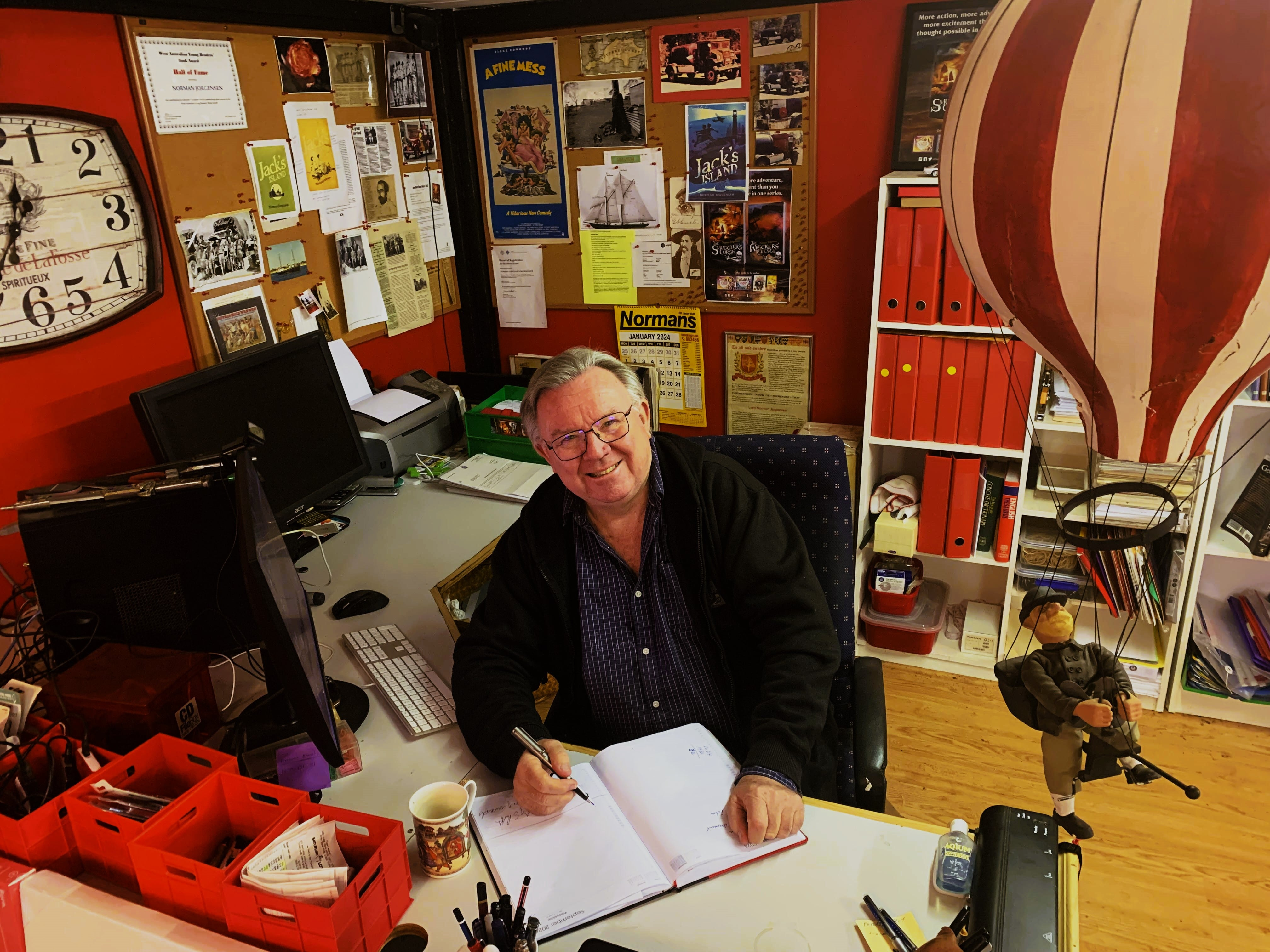
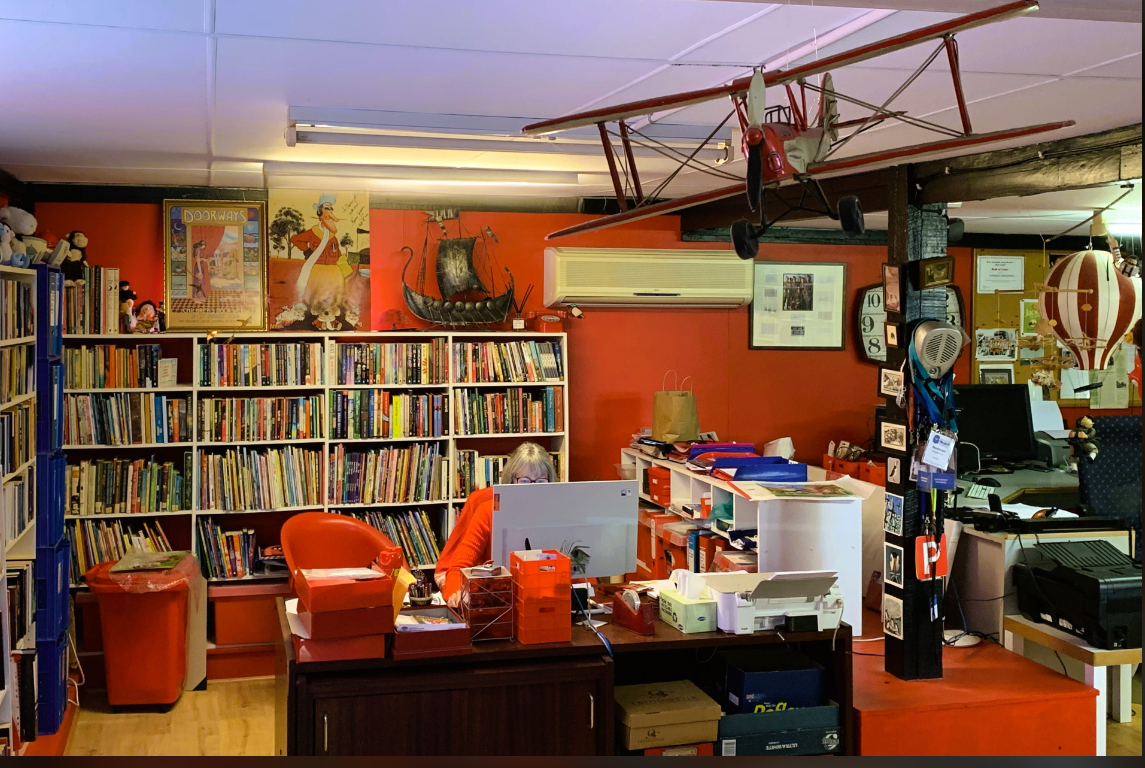
Please tell us about your working day and space –we are sticky beaks, so we would love to see pics if possible!
I have a studio at the bottom of the garden, near the toadstool circle and the fairy ring, and every day, I get out of bed, get appropriately dressed, lock up the house and walk down the garden path, and through the snow and past Forest of Ents, to work. I could wear my dressing gown or trackie pants as no one will see me, but I treat it as a job. Once there, I turn off all the lights, so there is darkness and only a blank white screen. I then wait for my imaginary characters to arrive so I can start typing their story. And some days, they fail to turn up. So then I‘ll type the words to a song, a shopping list, or a list of jobs to do around the house – anything to break that terrifying white space. Eventually, a character will poke their head into my imagination. I say hello, begin deleting all the junk, and start the day
John Steinbeck suggested you should only write one page a day and if you finish early, go back and polish it. At that rate, by the end of the year, you will have 365 polished pages, the right amount for a book. I try to follow this advice, unless it is flowing well, then I ignore the Nobel Prize-winning writer and keep at it until I’m exhausted. This is probably why John was an international writing god, and I am not.
What is the best part about being a writer? What would you be doing if the whole writing thing hadn’t panned out so well?
There are a lot of good parts to being a writer. The first, for me, is where the slightest glimpse of an idea starts to niggle in your mind. It can be anything -an image of someone being bullied, a story Elspeth, my sister-in-law, told me about her brother teasing her and calling her a Dafty, my dad talking about his boyhood, of a passage in RLS’s Kidnapped where a boy is sold by his uncle to a sea captain. You wonder if that could be the start of a new story, and most of the time, it just fades away, but occasionally, justoccasionally, it keeps on developing in you and stays, so you begin making a few notes.
My next step is to visit the locations I’ll use, then sit under a tree, start writing in longhand, and see where the characters take me. I usually have no idea in advance what will happen, and it is as if another person is inside me and has control of my pen.
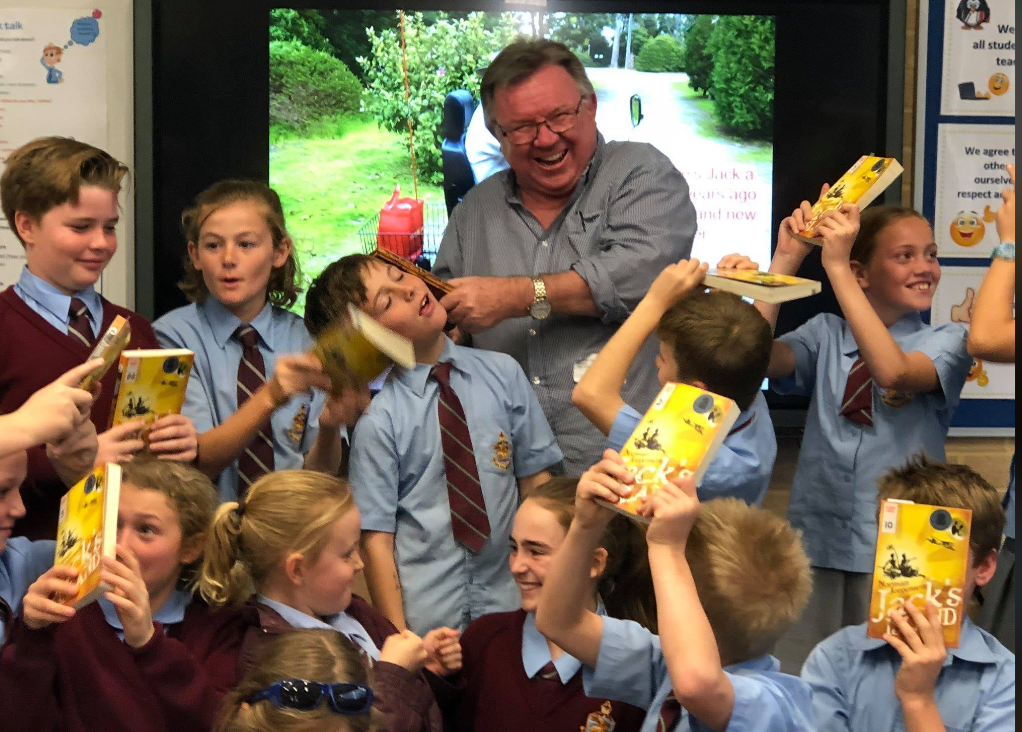
Finding the finished book with a flash new cover in a bookshop is also wonderful, almost unbelievable. I like the reaction of the audience when I am talking at lit festivals and to school groups, and I love how kids will come up to me when I’m packing up to ask extra questions and talk about my session.
People tend to treat you like you are a bit special too, so there is a danger of becoming too self-centred, as it all becomes about you all the time. When you meet people for the first time, they always want to ask about your books and your life as a writer, and so you tell them, even though you want to know about them and their lives. I am a bit self-centred, but as I didn’t get published until I had many years in the real world, I am more realistic and try not to be too much of a prima donna.
If it hadn’t panned out, what would I be doing? That’s a bit
like asking what do you want to be when you grow up? Okay, here goes…
b. A gangster in Depression-era Chicago with a big Black Cadillac, a Tommy Gun and a black-widow style girlfriend.
c. Robin Hood.
d. John Wayne, or Clint Eastwood.
e. Captain Blood, the Caribbean pirate.
f. Steven Spielberg.
g. Winston Churchill. I am actually starting to resemble him these days.
h. John Steinbeck, after he won the million-dollar Nobel Prize.
[Los<<<<<<😂😂😂😂😂😂😂😂]
I know you love to travel. What’s been your favourite destination or travel experience? Are there any plans afoot for the next trip?
One of the best trips was when my family took a long leisurely journey down the Mekong River in Vietnam on a Pandaw teak and brass river boat, sitting under canvas on the top deck, watching the busy life on the river pass by. Every day, we’d go ashore to visit remote villages and plantations and meet local traders, and most evenings, we would watch the sunset and stars while drinking non-alcoholic gin and tonics.
Next year, we have booked a trip on the Silk Road, starting in Xian, home of the Entombed Warriors, and then onto Nepal, Mongolia and out into the Taklamakan Desert. I suspect my Canon D7 (or newer model) will run piping hot, right?
What about the next book? What’s in the works, and when might we expect to see it?
It is called SAS: Secret Agent School and is about the Australian Government selecting the brightest and best kids in all the schools across Australia to attend SAS boarding school to learn how to be spies, as kids are mainly invisible to most adults, and no one would suspect them. Unlike the other trainees, who are all straight-A sporting stars, my hero, Dirk Fleming, is an utter dropkick nerd of a kid addicted to computer games, and is selected due to a clerical error. Training camp is horrendously difficult for a weedy kid like him and it nearly kills him. Still, he is brave and tenacious, and by the time the school realises they have the wrong D Fleming, Dirk has grown into the position, and his computer game reflexes have been appreciated as he becomes a master at all the James Bond gadgets and vehicles the young spies operate. He finally graduates with flying colours, and he and his friend, Natalia Molotov, are sent on their first real mission.
I had such fun writing it, returning to my James Bond collection. I named each chapter after a Bond Film, like No Time to Die and On Her Majesty’s Secret Service, but I have only just finished it, so I have no idea if a publisher will accept it. All the thousands of kids I tested the outline on during CBCA Book Week seemed very excited about it, so I am hopeful it will come out.
What about downtime? When you’re not working, how do you like to spend relaxing time?
I am good at idle. I can waste hours on Google, Facebook, and YouTube. I love watching old movies, especially Westerns, as I mentioned. I read historical fiction mostly, and I like woodwork. I have a shed full of expensive DeWalt electric toys like saws, drills and planers. My favourite downtime activity is photography, especially travel photography. I have a Canon D7 camera, and I’m trying unsuccessfully to justify upgrading it.
If you had to sum yourself up in 6 words, they would be…?
I had to ask my wife for this one. Here’s what she said:
“Twelve-year-old child trapped in a man’s body.”
(You probably guessed that after reading my answers.)
[hahaha! thanks Jan!]
What would you like your epitaph to be?
Here lies Norman Jorgensen, shot by a jealous lover at age 97.
He sure could tell a rollicking good story.
Norman, thank you so much for an fulsome and entertaining peep into your life and work! It was a blast (just like a pirate ship cannon!)


 Just So Stories
Leave a comment