


Harper Collins Australia
June 2025
- ISBN: 9781460765906
- ISBN 10: 1460765907
- Imprint: HarperCollins AU
- List Price: 17.99 AUD
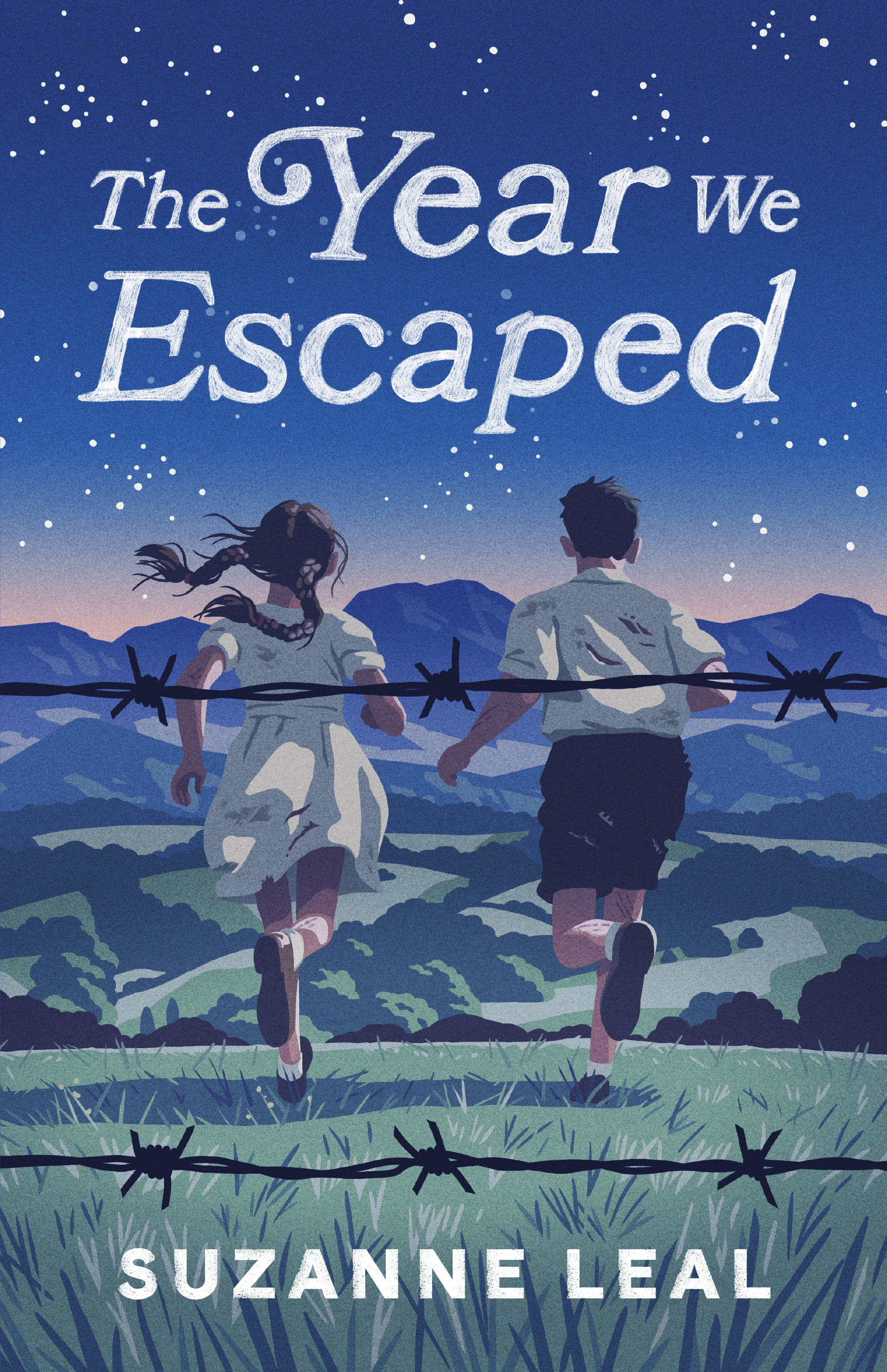
Suzanne Leal’s Running with Ivan was a book that took me to a very different part of the Second World War, and it was a privilege to write the teaching notes for it. I was lucky enough to be asked to write them for this new book as well.
And yet again, I add to my store of knowledge about the plight of the marginalised, the despised, the victimised, and the murdered. At the same time, readers will realise more about the resilience of the human spirit and the capabilities of even youngsters when faced with extreme circumstances.
Klara and Rachel are classmates in Germany. Jewish classmates. They and their families are immediate targets for the Nazis. Klara and her mother lose their store and then lose their home.
And in France, Paul and Lucien face the same problem but for a different reason. Their mother is Jewish, though their father is not. Nobody knows until the past rears up in the woman’s face.
The children and the mothers are sent from opposite directions to an internment camp called Gurs, at the foot of the Pyrenees. While it was not a death camp, many prisoners did die there due to poor conditions, malnutrition, and the brutality of the oppressors.
But there are some moments when the youngsters are uplifted. The teacher appointed to the ‘school’ held in an almost derelict barracks, Horst Rosenthal is an inspiration to them. And a revelation to me. I had not heard of this talented cartoonist before this, just as I had not heard of the camp.
There are other shafts of light in their dark times and in particular, the opportunity for Klara and Rachel to be given refuge in a remote French village. Paul and Lucien, now their friends, determine to escape and follow them to their safe haven, despite the enormous risks and the extreme danger. It is a stirring adventure narrative and makes for a marvellous read-around-your-topic book for lower to mid secondary as well as astute upper primary readers. It is definitely a 5 ✡️✡️✡️✡️✡️ rating.
As often happens, I included far more in the teaching notes than was needed so below are some extras not in the published version.
Analyse – Visual Literacy: There are only three examples of Horst Rosenthal’s cartooning and very little known about this young man, who was murdered in Auschwitz immediately on his arrival in 1942. Of the three, it is arguably ‘Mickey au Camp de Gur’ his 16-page comic book featuring Mickey Mouse as an internee at Gurs, that has created much interest in modern times. Lucien also loves to draw, and in the narrative is encouraged by Herr Rosenthal. Have the students create a short comic strip which might capture part of the narrative, e.g. one chapter or their own interpretation of some aspect of life in the camp. [Canva has many templates freely available for educators]. Consider these during the creation of the comics.
Do your images convey as much meaning as the text? Comics are often dialogue heavy.
How can you convey the emotions of the character/s?
What important point is the take-away from your comic?
What was happening at the time in history?
What feelings does it evoke?
Use Google Earth to explore places/locations mentioned in the text. Use a simplified map to trace the children’s train journey from Gurs to the Vivarais Plateau: Pau, Toulouse, Limoges, Paris, Le Chambon-sur-Lignon.
How far is it?
How long did it take the boys to get there? Why did it take so long?
How long would it take now ? Would one still go by train?
Kindness: Despite the ordeals the characters experience there are also examples of kindnesses. e.g. Kindness Caramels! A whole bag of them. ‘Are you sure, Monsieur?’ The man let out a laugh. ‘I am not monsieur, I am Carlos. And yes, I am sure. It is my very great pleasure. [p. 166]. Find other quotes that demonstrate kindness.
Luck: Not just lucky: four was the luckiest number of all, as Frau Finkel so often told us. It was the number of balance, and the number of leaves on a four-leaf clover. One leaf for respect, one for abundance, another for love and the last for health. [p. 134]. Luck is mentioned numerous times throughout the narrative. Have students be detectives to find the mentions and characterise luck in the context of the story/plot.
Lebkuchen: What is it in English? Find a recipe, write your own and illustrate it OR write a script and video the making of it.
Klara mentions her wooden pencil box. These were still popular right up to the 1960s. Find pictures to show what they looked like. Some families might still own one to show readers. Can students draw one to show what Klara’s might have looked like?
Barbed wire is a prominent aspect of the camp.
Fun fact: Did you know there are collectors of the different types of this?
Who invented barbed wire?
Research and sketch different types and label them.
What other uses does barbed wire have?
Most students would find it hard to comprehend how uncomfortable the straw-filled sacks for bedding could be. Hessian sacks could be obtained (try produce stores, horse stables or similar) and stuffed with shredded paper or similar to be in the classroom to try out for comfort!
Center for Jewish History: Gurs (Concentration camp) Collection
Spanish Civil War The Concentration Camp at Gurs (France)
Related resources
Companion Texts:
Running with Ivan – Suzanne Leal
All the Beautiful Things – Katrina Nannestad
We are Wolves– Katrina Nannestad
Rabbit Soldier Angel Thief– Katrina Nannestad
Waiting for the Storks – Katrina Nannestad
The Dollmaker of Krakow – R. M. Romero
White Dove – R. J. Palacio
Journey into War – Margaret Donaldson
When Hitler Stole Pink Rabbit – Judith Kerr
I am David – Anna Holm
Interned – Pamela Rushby
True Life stories:
Hana’s Suitcase: A true Story – Karen Levine
I am Sasha – Anita Selzer
Hiding Edith – Kathy Kacer
Useful Links
This French Town Has Welcomed Refugees for 400 Years
Memoir de Geurre [a wealth of information]
France And The German Occupation Period
1940-1944, Paris During the Occupation: The Untold Story of the German Soldiers
Child Memories from the Occupation and Liberation of Paris
How the Hitler Youth Turned a Generation of Kids Into Nazis
Blending Words & Images for Sketchnotes
Film:
 Just So Stories
Leave a comment